

Bluegrass Gardening
Last Updated: November 1, 2026
Quick Summary
To fix backyard drainage, first diagnose where water pools and why, then regrade the soil to move water away from the house, and install a French drain or swale where surface fixes won't reach. Extending downspouts and amending soil solve many smaller cases before major work.
- Walk the yard during heavy rain to note where water sits longest and why.
- Yard grading solves more drainage complaints than any other single step.
- A French drain intercepts subsurface water a surface fix can't reach.
- Call 811 a few business days before digging to locate public utilities.
- Grading, French drains, and swales are pro work, not DIY projects.
Table of Contents
- Start by Diagnosing Yard Drainage Problems and Causes
- Use Yard Grading for Drainage That Moves Water Away
- Install a French Drain for Backyard Drainage That Won't Quit
- Build a Drainage Swale for Yard Runoff
- Fix the Small Things First: Downspouts, Gutters, and Soil
- Know the Permits, Utilities, and Local Rules Before You Dig
- Decide What to Fix Yourself and What to Hand to a Pro
- Schedule a Drainage Assessment for Your Yard
- Frequently Asked Questions
Start by Diagnosing Yard Drainage Problems and Causes
Standing water after heavy rain is the clearest sign of a backyard drainage problem, and most cases trace back to one of four causes: a low spot that holds water, compacted or clay-heavy soil that absorbs slowly, a slope that sends runoff toward the house, or gutters and downspouts that dump water where it can't escape.
Read the Water: Where It Pools and Why
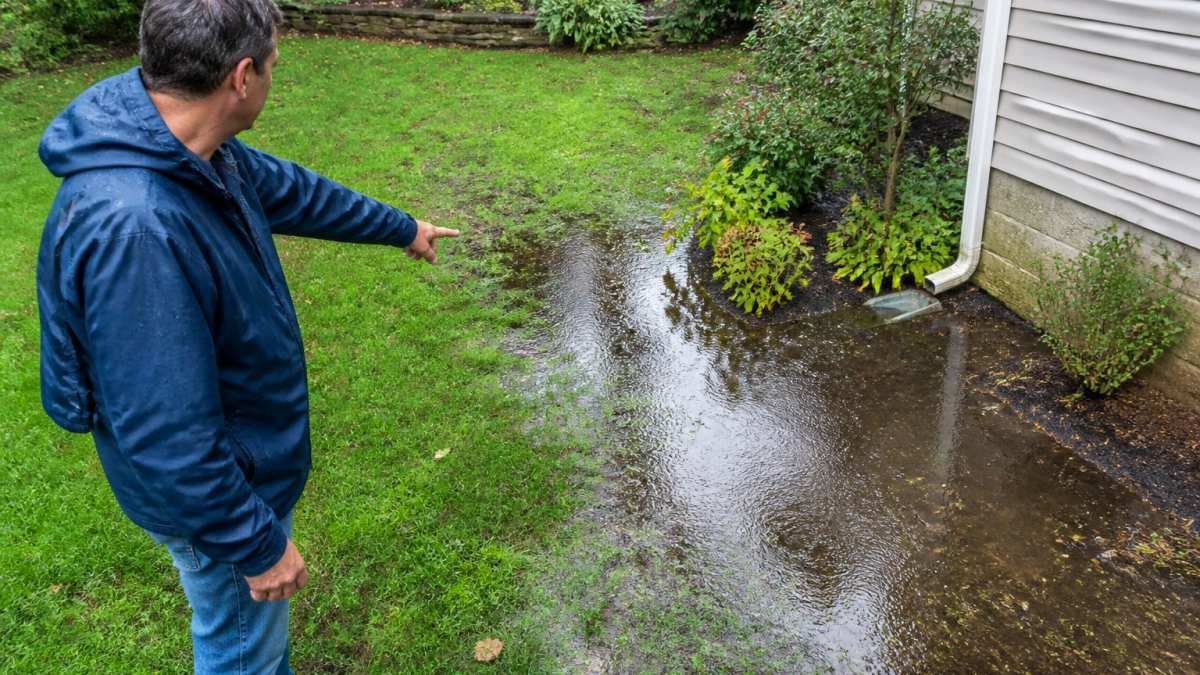
Walk your yard during or right after a heavy rain. Note the spots where water sits longest.
- Water against the foundation: runoff is coming toward the house, not away
- A bowl in the middle of the yard: the low point has nowhere to drain
- Water along a fence or bed edge: soil is compacted or the bed sits too high
Each pattern points to a different fix. Guessing wastes money.
Check the Soil and the Slope
Clay soil is common in established neighborhoods, and it drains slowly. Push a screwdriver into the ground after rain. If it barely goes in, compaction is part of the problem.
Slope matters just as much. Water needs a path away from the house. If the ground is flat or tilts back toward the foundation, no amount of gravel will fix it until the grade changes.
Watch out: water pooling near a basement wall or foundation is the one pattern you shouldn't sit on. If you suspect chronic flooding, our guide on why your yard is always flooded and how hardscaping fixes drainage walks through how design solves it at the project level.
Use Yard Grading for Drainage That Moves Water Away
Yard grading for drainage means reshaping the soil surface so water flows away from the house and toward a safe outlet.
The goal is simple: a gentle fall away from the foundation, then a steady path to the street, a swale, or a planted bed that can take the water.
Good grading work involves:
- Stripping and rebuilding the surface rather than piling dirt against the wall
- Checking the fall with a level so water actually moves
- Tying the new grade into beds and hardscape so it doesn't wash out
Regrading a sloped yard often pairs with a retaining wall. Our page on retaining wall solutions for sloped yards covers how that works in practice.
Install a French Drain for Backyard Drainage That Won't Quit
A French drain is a gravel-filled trench holding a perforated pipe that collects subsurface water and carries it to a safe outlet. It's the right tool when water sits below the surface and keeps a lawn soggy long after the rain stops, or when a wet layer persists against a foundation wall.
Surface fixes won't touch that kind of water. You need to intercept it underground, before it reaches the house or the low corner of the lot.
How a French Drain Is Actually Laid Out
Most residential French drains follow one of three layouts, and the layout matters more than the pipe:
- Foundation perimeter run , a trench parallel to the footing, set a few feet out, intercepting water before it reaches the wall. This is the layout for basement seepage and damp crawl spaces.
- Cross-slope intercept , a trench running across the direction water travels underground, catching a wet layer moving downhill toward a low spot.
- Low-point collector , a short run at the bottom of a bowl or against a retaining wall, where water accumulates and has nowhere to go.
A common mistake is running a single trench in the wrong direction. If the trench runs parallel to the flow instead of across it, water simply travels alongside the pipe and keeps going.
The Parts That Decide Whether It Works
A French drain only performs if every part is right, and the details are where most failures happen:
- A trench that slopes continuously to the outlet. Even a short flat or reverse-pitched stretch becomes a settling chamber that silts up and stops flowing.
- Correct trench depth to reach the waterlogged layer. Too shallow and it sits above the water; too deep and it may intercept a deeper flow you didn't intend to redirect.
- Washed gravel, not fill dirt or crushed limestone with fines. Fines wash into the pipe and clog the perforations.
A common mistake is digging a trench and filling it without checking the fall. If the pipe runs uphill even slightly, it holds water and fails, and by then the trench is backfilled.
Outlet Placement Is Half the Design
The outlet is where most French drains quietly fail. A drain that terminates in a low corner of the yard just relocates the puddle. A drain that discharges onto a slope without erosion protection cuts a channel.
Good outlets generally share a few traits: they daylight at a point lower than the entire trench, they discharge onto stable ground or decorative stone rather than bare soil, and they're accessible enough to inspect after a heavy rain.
Maintenance and What to Expect
A French drain is not install-and-forget. Plan on checking the outlet after major storms, clearing leaf litter and sediment from the discharge point, and watching for soft spots along the trench line that signal clogging.
For a real example of a persistent problem solved through design, see how we handled a drainage issue with functional landscape design. If you're weighing a French drain against regrading or a swale, a site assessment is the fastest way to know which one your yard actually needs.
Build a Drainage Swale for Yard Runoff
A drainage swale is a shallow, gently sloped channel that carries surface runoff across a yard to a safe outlet. It's the surface-water counterpart to a French drain, and it suits yards where water sheets across the ground rather than sinking in.
Swales work well when:
- Runoff crosses the yard from a neighbor or a higher grade
- You need a path for water that won't erode the soil
- The outlet is downhill and accessible
A swale can be planted with tough perennials or decorative stone so it reads as a landscape feature, not a ditch. Build it too steep and water scours the bottom. Build it too flat and it just holds water.
Fix the Small Things First: Downspouts, Gutters, and Soil
Before committing to major work, check the cheap fixes. Downspout extensions, clean gutters, and soil amendments solve a surprising share of backyard drainage problems.
- Extend downspouts several feet from the foundation so water lands on the yard, not the wall
- Clear gutters and check for overflow during heavy rain
- Aerate compacted soil to let surface water soak in
These steps won't fix a grade problem or a high water table. But they're the first thing to rule out, and they make every larger fix work better.
Know the Permits, Utilities, and Local Rules Before You Dig
Most drainage guides skip this step entirely, and it's the one that can turn a weekend project into a liability. Before any trench is cut or grade is changed, three things need checking: buried utilities, local stormwater and grading rules, and where the water will end up once it leaves your property.
Call 811 Before You Break Ground
Every state operates a free utility locate service reached by dialing 811. Call it a few business days before digging and wait for the marks before any shovel goes in.
What 811 does not locate is private lines on your side of the meter, landscape lighting feeds, irrigation lines, a private sewer lateral, or a gas line to an outbuilding.
Check Local Grading and Stormwater Rules
Drainage work touches two regulatory areas that homeowners rarely think about:
- Grading and drainage permits. Many jurisdictions require a permit for significant regrading or work that changes how stormwater leaves a lot. Rules vary, so a quick call to the local building department before design saves rework.
- Stormwater and discharge rules. Some areas prohibit tying a French drain or downspout into the sanitary sewer, restrict discharge onto public right-of-way, or require on-site retention. Others have erosion and sediment control requirements during construction.
A short call to the building department and, where relevant, the local stormwater authority answers both questions. It's the cheapest part of the project and the one most likely to be skipped.
Don't Send Water Onto a Neighbor
This is the rule that causes the most disputes. Directing runoff onto a neighboring property, or concentrating it at a property line, can create a legal problem and a relationship problem at the same time.
In practice, that means the outlet of any French drain, swale, or regrade should discharge to a point on your own property, to a public storm system where allowed, or to a designed infiltration area, not over the fence line.
When to Bring in a Professional
Utility locating and permit checks are things a careful homeowner can start, but interpreting the results, and designing around a private line, a setback, or a stormwater restriction, is where experience matters. A professional assessment confirms what's underground, what's allowed, and what the outlet plan should be before anyone commits to a trench. Our guide on what affects landscaping costs explains the factors that drive a project's price, so you can compare quotes with clear eyes.
Decide What to Fix Yourself and What to Hand to a Pro
Small fixes are reasonable DIY territory: extending a downspout, clearing gutters, spreading compost. Grading, French drains, swales, and retaining walls are not.
Those projects depend on getting the slope, depth, and outlet right. Get one wrong and you've spent money to move water somewhere worse. A professional assessment also tells you what the fix will actually involve before you commit.
| Problem | Best First Fix | DIY or Pro |
|---|---|---|
| Water at downspouts | Downspout extension | DIY |
| Slow-soaking soil | Aeration and compost | DIY |
| Low spot holding water | Regrading | Pro |
| Soggy ground below surface | French drain | Pro |
| Runoff crossing the yard | Swale | Pro |
| Water against foundation | Grading plus drainage | Pro |
Schedule a Drainage Assessment for Your Yard
A drainage assessment is a site visit that identifies where water comes from, where it pools, and which fix will actually solve it. It turns a list of guesses into a plan.
At Bluegrass Gardening, we look at grade, soil, downspouts, and outlets together, because drainage problems rarely have a single cause. Because the fix often reshapes beds and lawn at the same time, we can fold the drainage work into broader residential landscaping and garden design so the yard drains properly and looks intentional rather than patched.
You don't need to know which one yet. That's what the assessment is for. If you have questions about process or service area first, our FAQ page has quick answers.
Frequently Asked Questions
How does a French drain work?
A French drain is a gravel-filled trench holding a perforated pipe that collects groundwater and carries it to a lower outlet. Water enters through the gravel, flows into the pipe, and drains away from the wet area. For it to work, the trench needs the right slope, filter fabric to keep soil out, and somewhere for the water to go. Without a working outlet, a French drain just moves the problem a few feet away.
Can I dig a hole and fill it with gravel for drainage?
A gravel-filled hole, sometimes called a dry well, can soak up a small amount of water in sandy soil, but it is not a real fix for backyard drainage. In Louisville's heavy clay, the hole fills up and stops absorbing. It also does nothing for water running across the surface. Treat it as a temporary patch, not a solution, and fix the grade or add a proper drain instead.
Does a French drain need an outlet?
Yes. A French drain without an outlet is just a storage trench, and it will overflow in the first heavy rain. The outlet can be a daylight pipe at a lower point on the property, a storm sewer connection where local rules allow it, or a dry well sized for the volume. Confirm the outlet before any digging, because it often decides whether a French drain is even possible on your lot.
Who do I call to fix drainage in my yard?
Call a landscape professional who handles drainage and grading, not a general handyman. The right pro will assess your slope, soil, and water source, then recommend a fix such as regrading, a French drain, or a swale. Ask for examples of similar projects and a clear explanation of where the water will go.
Water that pools against your foundation or keeps a corner of the yard soggy all season won't fix itself, and the longer it sits, the more it costs to correct. Bluegrass Gardening designs drainage and grading solutions around your specific site, from regrading and French drains to planted swales that double as landscape features. Get started with Bluegrass Gardening and turn a wet, unusable yard into space you can actually enjoy.
News & Articles
Browse Our Newsletter


Get Started Today
Your Landscape Deserves Someone Who Understands It
Whether you're planning a full garden renovation, a seasonal reset, or a smarter planting plan for your front yard, we're ready to help. Get in touch today, and let's talk about what your property needs.