

Bluegrass Gardening
Table of Contents
- Start With a Backyard Landscape Design Plan
- Overgrown Backyard Cleanup and Redesign: What Goes First
- Backyard Landscape Renovation Ideas That Fit Real Yards
- Fix Drainage and Soil Before You Plant Anything
- A Realistic Landscape Renovation Timeline
- Common Mistakes Homeowners Make With an Overgrown Yard
- Frequently Asked Questions
Last Updated: October 8, 2026
Start With a Backyard Landscape Design Plan
Transforming an overgrown backyard landscape design starts with a written plan, not a shovel. A backyard landscape design plan is a simple document that maps what you have, what you want, and the order you will tackle each job. At Bluegrass Gardening, we have walked many yards in Anchorage, Middletown, and the Highlands, and the homes that turn out best are the ones that start on paper.
Here is why that matters. An overgrown yard hides problems. Brush covers a broken walkway. Vines climb a fence that is already leaning. If you start cutting without a plan, you often remove something you wanted to keep.
So the first step is not buying plants. It is looking, measuring, and writing things down.
Walk the Yard and Map What You Have
Walk your yard in the morning and again in the late afternoon. Light changes a lot between those hours, and it decides what will grow where.
Bring a notebook and a phone. Note these things:
- Which areas get full sun, part shade, or deep shade
- Where water pools after rain
- Which plants look healthy and which look half dead
- Where the ground slopes toward or away from the house
- Any hardscape you want to keep, like a patio, path, or retaining wall
Sketch the shape of the yard on paper. Mark the house, the fence line, and any trees. It does not need to be pretty. It needs to be accurate.
A simple trick: pace out the yard and count your steps. Most people walk about 2.5 feet per step, so 40 steps is roughly 100 feet.
Set Priorities Before You Spend a Dollar
List every job you can think of, then sort the list into three groups:
- Must fix - drainage, dead trees, unsafe steps, broken fencing
- Want soon - new beds, a sitting area, better privacy
- Someday - lighting, water features, a second patio
Spend your first dollars on the must-fix group. This is the part most homeowners skip, and it is the reason so many renovations look good for one season and then fall apart.
Overgrown Backyard Cleanup and Redesign: What Goes First
Overgrown backyard cleanup and redesign should follow one order: clear, assess, repair, then plant. Clearing comes first because you cannot judge what you have until you can see it.
Start with a full day of removal. Cut back vines, pull weeds, and haul out dead brush. Bag yard waste as you go so the pile does not take over the yard.
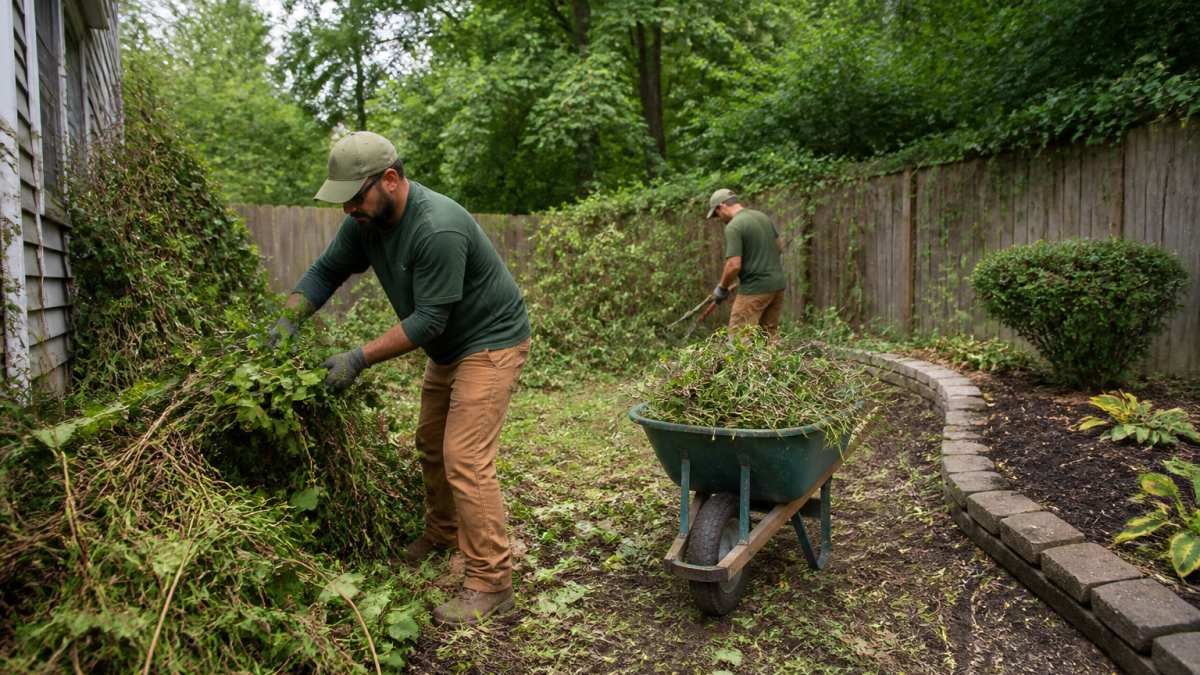
Once the yard is clear, walk it again. You will spot things the brush was hiding: a cracked walkway, a stump, a low spot that holds water.
Then handle repairs. Reset loose pavers. Fix or replace damaged fence sections. Remove stumps that sit where you want to build.
Only after that do you plant.
Which Plants Are Worth Keeping
Keep a plant if it is healthy, suited to its spot, and something you actually like. Remove it if it is diseased, invasive, or in the wrong place.
Check these signs before you decide:
- Keep: firm stems, new growth in spring, no visible rot or pest damage
- Remove: dead wood through most of the trunk, fungal growth at the base, roots lifting a walkway or foundation
- Move: healthy plants that are simply in the wrong spot, such as a sun lover stuck in shade
Some plants are worth a second look. A mature tree that shades the west side of a house is hard to replace and takes decades to grow back.
Others are not worth saving. If a shrub has been cut back hard for years and looks woody and thin, replacing it is usually cheaper than trying to revive it.
Backyard Landscape Renovation Ideas That Fit Real Yards
Backyard landscape renovation ideas work best when they match the size and shape of the space you actually have. Small, oddly shaped yards in St. Matthews and the Highlands often gain more from smart layout than from expensive materials.
Here are approaches we use again and again:
- Layer the beds. Tall plants in back, mid-size in the middle, low plants in front. This adds depth to a shallow yard.
- Curve the edges. A curved bed line makes a small yard feel larger than a straight one.
- Add one focal point. A single tree, a stone bench, or a dry creek bed draws the eye and gives the space a center.
- Use paths to guide movement. A path from the back door to a seating area tells people where to go.
- Screen with structure. A trellis, a low wall, or a row of shrubs can create privacy without a full fence.
For a narrow yard, run the design lengthwise. For a wide, shallow yard, break it into two zones: one for sitting and one for planting.
Hardscaping is where a lot of yards gain function. A small patio off the back door often gets used more than a large one at the far end of the yard.
If you want help shaping these ideas into a plan, our garden design service covers layout, plant selection, and hardscape placement.
Fix Drainage and Soil Before You Plant Anything
Drainage and soil decide whether your new plants live or die. This is the least exciting step and the most important one.
Walk your yard after a heavy rain. Note where water stands for more than a day. Those spots need a fix before anything goes in the ground.
Common fixes include:
- Regrade the soil so it slopes away from the house
- Add a dry creek bed to carry water to a safe spot
- Install a French drain where water collects in a low area
- Build a rain garden with plants that tolerate wet roots
Soil matters just as much. Heavy clay is common in this area, and it holds water and drains slowly. Mix in organic matter to loosen it and help roots spread.
Test your soil before you plant. A simple home test kit shows the pH and nutrient levels.
Get this step right and everything after it gets easier.
A Realistic Landscape Renovation Timeline
A landscape renovation timeline depends on the size of the yard and how much hardscape is involved. Most residential projects run across several phases rather than one long push.
Here is how we usually break it down:
| Phase | Typical Duration | What Happens |
|---|---|---|
| Plan and measure | 1-2 weeks | Walk the yard, set priorities, sketch the layout |
| Cleanup and removal | 1-3 days | Clear brush, remove dead plants and stumps |
| Drainage and soil work | 3-7 days | Regrade, add drains, amend soil |
| Hardscape | 1-3 weeks | Patios, paths, walls, edging |
| Planting | 2-5 days | Trees, shrubs, perennials, ground cover |
| Mulch and finish | 1-2 days | Mulch beds, water in, clean up |
Small yards with light work can wrap up in a few weeks. Larger projects with patios and retaining walls take longer, and weather can push dates back.
Common Mistakes Homeowners Make With an Overgrown Yard
Most overgrown yard projects go wrong in the same few ways. Avoiding these saves time, money, and a lot of frustration.
- Skipping the plan. Buying plants before you know the layout leads to wasted money and plants in the wrong spots.
- Ignoring drainage. New beds in a wet area will fail, no matter how good the plants look on day one.
- Cutting everything down at once. You lose good plants along with the bad, and you lose the shade and screening you already had.
- Choosing plants by looks alone. A plant that needs full sun will struggle in shade, no matter how healthy it was at the store.
- Forgetting maintenance. A new landscape needs watering and weeding in the first year. Plan for it.
- Doing it all in one weekend. Big projects done fast usually cut corners on soil prep and drainage.
The real difference between a yard that holds up and one that fades comes down to prep work. Plants are the last step, not the first.
That is also where ongoing care matters. Beds need weeding, shrubs need shaping, and young trees need water through dry spells. Our seasonal maintenance service keeps a renovated yard looking finished instead of letting it slide back.
An overgrown yard can feel like a lost cause, but it rarely is. The fix is a clear plan, honest priorities, and the patience to handle drainage and soil before you plant a single shrub. Bluegrass Gardening handles residential landscaping, garden installation, and custom planting for homeowners in Anchorage, Middletown, Prospect, Crestwood, and nearby neighborhoods. We start with a walk-through, build a plan around your space, and handle the work from cleanup to the final mulch. Contact Us to schedule a visit and get a plan for your yard.
Frequently Asked Questions
How do you start transforming an overgrown backyard?
Start by walking the yard and writing down what is actually there: dead shrubs, volunteer trees, broken hardscape, and any spots that stay wet after rain. Take photos from the same angles so you can track progress. Then decide what you want the space to do, such as more privacy, a seating area, or a clear view. A written backyard landscape design plan keeps the project from turning into a series of impulse decisions.
What should you remove first when redesigning an overgrown landscape?
Clear the obvious problems first: dead or diseased plants, invasive vines, and anything blocking a walkway, window, or fence line. Next, pull volunteer trees and saplings before their roots get established. Leave healthy mature trees and shrubs in place until you have a plan for what replaces them, since removing a large plant changes light and drainage for everything around it.
How long does a backyard landscape renovation take?
Small yards with focused changes often wrap up in a few weeks. Larger projects that include regrading, drainage work, new hardscape, and planting can run several months, especially when work is split across seasons. A landscape renovation timeline usually separates demolition and grading from planting, because new plants establish better when they go in at the right time of year rather than all at once.
How do you make an overgrown backyard feel more private and usable?
Privacy and usability usually come from the same moves: define the edges of the yard, screen sightlines from neighboring windows, and create one clear gathering spot instead of scattering furniture. Layered plantings at different heights screen more effectively than a single row of shrubs, and they look better year-round. A designer can map sightlines from your patio, kitchen window, and property corners to place screening where it actually blocks the view.
News & Articles
Browse Our Newsletter

Get Started Today
Your Landscape Deserves Someone Who Understands It
Whether you're planning a full garden renovation, a seasonal reset, or a smarter planting plan for your front yard, we're ready to help. Get in touch today, and let's talk about what your property needs.