
Table of Contents
- What Drives Landscape Renovation Costs in Louisville in 2026
- How to Build a Realistic Backyard Renovation Budget
- What a Landscape Renovation Estimate Should Include
- Hardscaping Cost: Patios, Walkways, and Retaining Walls
- Landscape Project Timeline: How Long Your Yard Stays a Work Zone
- How to Compare Landscape Renovation Costs in Louisville 2026 Bids
- Long-Term Ownership Costs After the Renovation
- Conclusion: Planning Your Louisville Landscape Renovation
- Frequently Asked Questions
Last Updated: October 5, 2026
What Drives Landscape Renovation Costs in Louisville in 2026
Landscape renovation costs in Louisville 2026 depend on four things: yard size, site access, soil and drainage conditions, and the materials you choose.
Older properties in Anchorage and the Highlands tend to cost more to rework. Mature trees mean deep roots, shade, and compacted soil.
A common mistake is budgeting only for the pretty parts. The prep work is where the money goes.
How to Build a Realistic Backyard Renovation Budget
Start with a backyard renovation budget that separates design, site prep, hardscape, planting, and irrigation into their own lines. Homeowners who lump everything into one number almost always overspend, because they have no way to see where the money went.
A practical split looks like this:
- Site prep and grading as its own line
- Hardscape (patios, walkways, walls) as its own line
- Planting and soil amendments as its own line
That last one matters most. Underground surprises are normal in older Louisville yards: old footings, buried debris, and tree roots. Set aside a contingency so a surprise does not blow up the whole project.
What to Set Aside for Drainage, Soil, and Grading
Drainage, soil, and grading are the invisible line items that decide whether your renovation lasts. Wet spots that never dry, soil that drains poorly, and yards that slope toward the house all need correction before anything pretty goes in.
Ask your contractor to explain how they will move water away from the foundation. If the answer is vague, get another bid.
What a Landscape Renovation Estimate Should Include
A landscape renovation estimate should list labor, materials, equipment, disposal, and a project timeline in writing. If a bid is one page with a single number at the bottom, you cannot compare it to anything.
Every estimate should spell out:
- Scope of work, in plain language
- Materials by type and quantity
- What is removed and how it is disposed of
Ask whether the price includes cleanup and haul-away. Debris removal is often quoted separately, and it adds up fast on a full tear-out.
Hardscaping Cost: Patios, Walkways, and Retaining Walls
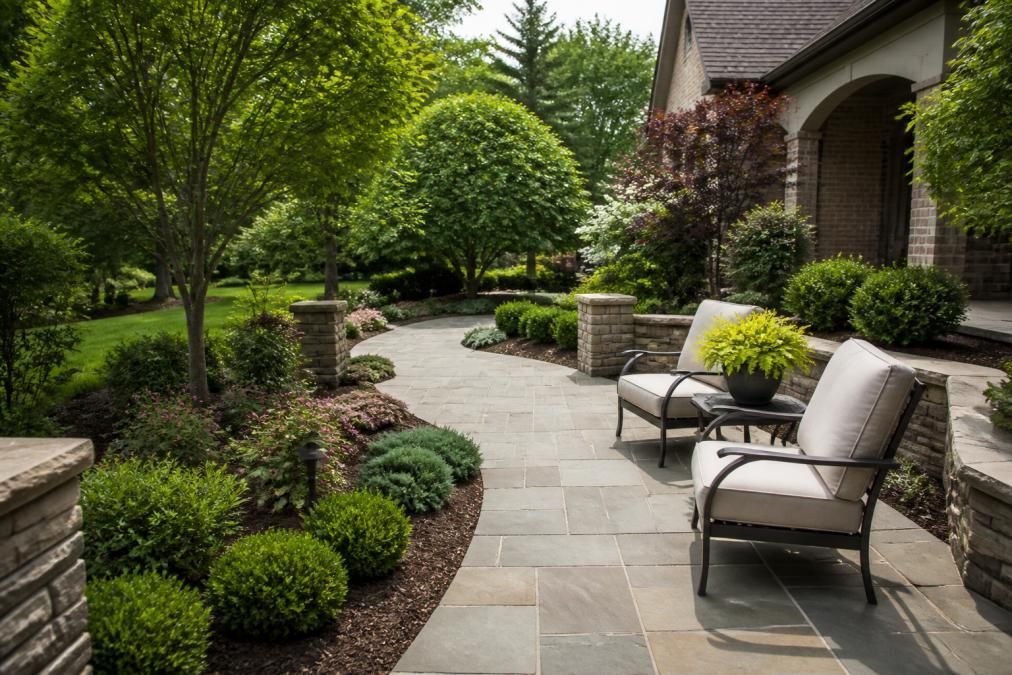
Hardscaping cost is driven by material, square footage, and how much base prep the site needs. A flagstone patio on a properly prepared gravel and sand base costs more up front than a simple poured surface, but it holds up far better to freeze-thaw cycles.
A landscaper in work clothes laying flagstone on a prepared gravel and sand base beside a Louisville home, with a wheelbarrow and hand tools nearby
What Actually Goes Into a Hardscape Bid
A hardscape quote is really four quotes stacked together. Ask your contractor to separate them, because each one moves independently:
- Excavation and removal. Digging out the old surface, hauling away broken concrete or old pavers, and disposing of it. On a full tear-out, this line alone can rival the material line.
- Base preparation. Crushed gravel, sand, compaction in lifts, and a geotextile fabric on soft ground. This is the invisible work that decides whether the surface stays flat after a winter of freeze-thaw.
- Material. Flagstone, clay or concrete pavers, natural stone, or poured surfaces. Material is usually the most visible line and the easiest to swap if the budget tightens.
When a bid collapses those four into one number, you cannot tell whether the savings came from a cheaper stone or from skipping compaction. Always ask which line was trimmed.
How Local Site Conditions Change the Number
Two yards the same size can get very different hardscape bids. The difference is almost always the site, not the design:
- Slope. A patio on flat ground is straightforward. A patio on a grade needs terracing, steps, or a retaining wall, and each of those adds its own base and drainage work.
- Access. A narrow gate in the Highlands or a steep drive in Prospect means crews carry material by hand or use smaller equipment. That slows the job and shows up in labor.
- Soil and drainage. Heavy clay that holds water needs deeper base and better drainage than sandy ground. If water already pools where the patio will go, that problem has to be solved first.
Patios, Walkways, and Retaining Walls: Different Jobs, Different Scope
These three get lumped together, but they are not the same project:
- A patio is a flat surface. Its cost is mostly base prep and material, and its main risk is drainage away from the house.
- A walkway is a narrow, linear surface. It is usually cheaper per square foot than a patio because there is less edge work, but curves and steps add labor.
- A retaining wall is a structure, not a surface. A wall holding back a slope needs engineering, proper footings, gravel backfill, and a drainage path behind it. A short garden wall a foot or two high does not. If a contractor quotes a tall wall like a garden wall, get a second opinion.
A retaining wall without drainage behind it will lean or fail within a few seasons. Water pressure builds up faster than most homeowners expect, and rebuilding a failed wall costs more than building it correctly the first time.
Before you sign, walk the site with your contractor and ask them to point out where water will go when it leaves the new hardscape. If they cannot answer clearly, that is a sign the drainage plan is an afterthought.
Landscape Project Timeline: How Long Your Yard Stays a Work Zone
A landscape project timeline usually runs from a few days for planting to several weeks for a full renovation with hardscape. Weather, material lead times, and permit requirements all affect the schedule.
| Project Scope |
Typical Duration |
Main Time Drivers |
|---|---|---|
| Planting refresh only |
2-4 days |
Plant availability, soil prep |
| Yard cleanup and debris removal |
1-3 days |
Volume of debris, access |
| Drainage and grading |
3-7 days |
Extent of the problem, weather |
| Patio or walkway installation |
1-2 weeks |
Base prep, material, curing |
| Full renovation with hardscape |
3-6 weeks |
Scope, permits, sequencing |
Ask for a schedule in writing before work starts. A crew that cannot tell you the sequence is a crew that will leave your yard torn up longer than promised.
How to Compare Landscape Renovation Costs in Louisville 2026 Bids
Comparing landscape renovation costs in Louisville 2026 bids means comparing scope, not just totals. The lowest number is often the one missing the most work.
The problem is that no two bids are written the same way. One contractor quotes a lump sum, another quotes by the square foot, and a third lists materials but not quantities. Before you can compare them, you have to normalize them.
Step 1: Put Every Bid on the Same Page
Take each bid and rewrite it into the same five categories, in the same order:
- Site prep and removal , what comes out, how it is disposed of
- Hardscape , surface type, square footage, base depth
- Planting and soil , plant count and size, amendments, mulch
- Drainage and irrigation , what is installed, where water goes
- Contingency and cleanup , surprises, haul-away, final walkthrough
If a bid has nothing under one of those categories, that is not a saving. It is a gap you will pay for later as a change order.
Step 2: Check the Quantities, Not Just the Materials
"Flagstone patio" tells you nothing. "Flagstone patio, 400 square feet, 4-inch compacted gravel base, sand-set, sealed" tells you everything. Ask every contractor to state quantities in writing:
- Square footage of hardscape
- Linear feet of wall or edging
- Number and size of plants
Two bids can name the same material and still differ by thousands because one is half the quantity or half the base depth.
Step 3: Read the Fine Print on What Is Excluded
Most disputes come from what a bid does not say. Look for these exclusions and ask about each one:
- Is debris removal and disposal included, or billed separately?
- Are permits and utility locates handled by the contractor?
- Is drainage addressed, or listed as "to be determined"?
A bid that answers all eight is worth more than one that undercuts on price and leaves half the work out.
Step 4: Ask About Change Orders Before You Sign
A change order is any work added after the contract is signed. They are normal on renovation projects, because old yards hide surprises. What matters is how they are priced. Ask each contractor:
- How do you price added work, by the hour, by the unit, or by a new quote?
- Do you get written approval before starting added work?
- Is there a markup on change orders, and how much?
A contractor who answers clearly is one you can trust when the unexpected happens. A contractor who dodges the question is one who will surprise you later.
Step 5: Compare Warranties and References
Price is only part of the value. Ask what happens if something fails:
- How long is the workmanship warranty?
- Does the manufacturer warranty the materials, and will the contractor handle the claim?
- Can you speak to two or three past clients with similar projects?
A slightly higher bid with a real warranty and reachable references is usually the better deal.
The cheapest bid is rarely the cheapest project. Missing scope items show up later as change orders, and change orders always cost more than if they had been in the original plan. Normalize every bid into the same categories before you compare totals.
Long-Term Ownership Costs After the Renovation
The renovation is not the end of the spending. Ongoing costs include seasonal maintenance, irrigation repairs, plant replacement, and periodic hardscape upkeep.
Plan for these:
- Seasonal cleanups and pruning
- Irrigation checks and winterization
- Mulch refresh and soil amendments
A well-built renovation lowers these costs over time, because the base work was done right. A cheap renovation raises them, because you pay to fix the shortcuts.
Conclusion: Planning Your Louisville Landscape Renovation
Getting a landscape renovation right comes down to planning the invisible work first: drainage, soil, grading, and base prep. The pretty parts are easy.
Bluegrass Gardening brings rooted knowledge and long-term thinking to every project, from garden design and planting to full landscape installation for homes across Anchorage, Middletown, St.
Contact Us to start planning your renovation and get a clear, itemized estimate for your yard.
Frequently Asked Questions
What factors affect the cost of a landscape renovation in Louisville?
Yard size and shape, access for equipment, grading and drainage fixes, soil condition, plant sizes, and hardscape materials all move the number. A corner lot in Middletown with a single frontage usually costs less to rework than a dual-frontage property in Indian Hills where crews must work from two sides. Old, overgrown beds and buried debris add labor. Ask any contractor to separate labor, materials, and site cleanup on the estimate so you can see which line items are driving your landscape renovation costs.
How much should I budget for a backyard renovation?
Start with a backyard renovation budget that covers four buckets: site prep, drainage and grading, planting, and hardscaping. Drainage and grading are the items homeowners most often underestimate, especially in yards with wet spots that never dry out. Set aside a contingency for surprises like buried roots, old concrete, or utility lines. Because pricing depends on scope, materials, and access, ask Bluegrass Gardening or another local contractor for a written estimate rather than relying on a national average.
How long does a residential landscape renovation take?
A landscape project timeline depends on scope. A planting and bed refresh on a small St. Matthews yard can finish in days, while a full renovation with drainage work, hardscaping, and new plantings in Prospect or Crestwood can run several weeks. Weather, permit approvals, and material lead times add days. Ask your contractor for a phased schedule that shows when the yard will be torn up and when each stage wraps, so you can plan around the disruption.
How can I compare landscape renovation quotes fairly?
Put every landscape renovation estimate side by side and check that each one lists the same scope: square footage, plant sizes, hardscape materials, drainage method, and debris removal. A low bid often skips soil amendment, gravel base depth, or site cleanup, which raises your landscape renovation costs later. Ask what is excluded, how change orders are priced, and whether the crew is in-house or subcontracted. Then compare two or three bids on scope, not just the bottom line.